
Movement and Mood in the Menopause Transition, Starting With a Morning Walk
Travel as Medicine · Movement
Movement and Mood in the Menopause Transition, Starting With a Morning Walk
A new review in the journal Menopause looked at exercise programs and mood in perimenopause and early postmenopause, and it gives the walk at the start of a travel day a little more weight.
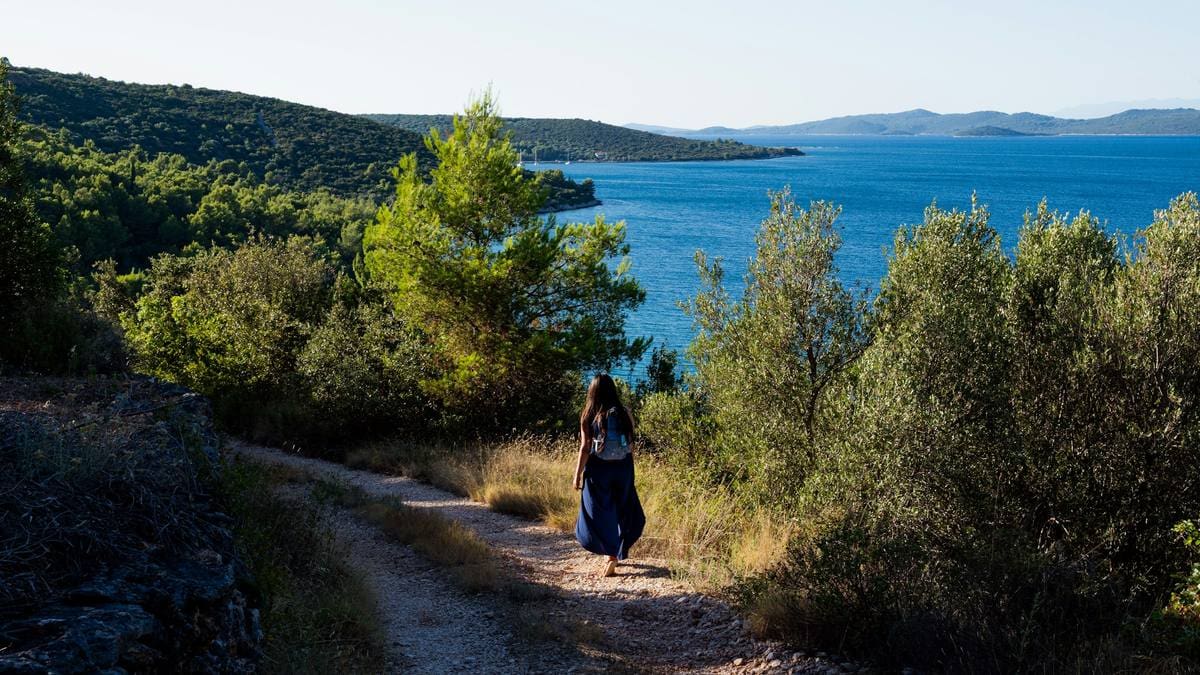
Picture the second morning of a trip, when the jet lag has eased and you’re out on a gravel path above a bay before the day gets warm. The olive trees are still in shade, the water below has gone from gray to a deep blue, and the walk down to the harbor for coffee takes about as long as it takes to stop thinking about your inbox. Nobody scheduled it as exercise, but your legs have been working for half an hour by the time you sit down.
Movement is the first pillar of the MNRC Method that I build trips around, which is why a new piece of research this month caught my attention, since it looked at how exercise relates to mood during the menopause transition.
What the review looked at
In October 2026 the journal Menopause published a systematic review and meta-analysis led by Simone Saidel, an NHS clinical psychologist who was a researcher at University College London when the work was done, with Professor Aimee Spector of UCL’s Menopause Mind Lab as senior author. The team pooled 12 randomized controlled trials that together included more than 1,000 women in perimenopause and early postmenopause, with studies run in Brazil, China, Tunisia, India, Iran, Korea and the United States.
The trials tested two broad kinds of programs. Aerobic-based programs included walking, Zumba, aerobic classes, dance and Taekwondo, while mind-body programs included yoga, tai chi, Pilates and stretching.
What it found
According to UCL’s summary of the paper, the aerobic-based programs showed the strongest effects on depressive symptoms and on overall quality of life, and they tended to involve fewer sessions. The mind-body programs were linked to strong improvements in psychological quality of life. The benefits for mood and quality of life showed up most clearly in early postmenopause, and physical activity was also linked to fewer depressive symptoms during perimenopause.
The authors also suggest that group formats may have helped, possibly through the social connection and peer support that come with moving alongside other people. That idea is the authors’ interpretation of the pattern, offered as a possibility.
Where the evidence stops
The researchers are open about the limits, and they matter. The evidence base is still small, the studies varied substantially from one to the next, and many of the trials were judged to be at high risk of bias, which is why the authors call for more high-quality trials. Every one of these trials tested a structured exercise program, so none of them measured travel, and the review can’t tell us what a walking trip does for mood.
What it does offer is a reasonable, modest signal that regular aerobic movement and mind-body practice are associated with better mood and quality of life during this stage of life, from trials designed to test that question.
How this shows up in the trips I plan
When I plan a restorative trip, movement goes into the days the way it would in a good week at home, as something built into the shape of the day. I look for a place where the morning walk is already part of getting somewhere, whether that’s a coastal path into town, a garden loop before breakfast or a hotel with a yoga class at a gentle hour, so the movement arrives without a single extra decision.
I also pay attention to the pace of the people traveling together, because a walk with friends where everyone can still talk easily has a very different feel from one where somebody is always catching up. The review’s note on group formats is a hypothesis, but it matches the instinct behind the Connection pillar, which is that moving alongside people you enjoy tends to make the movement easier to come back to.
For women in midlife, this is a quietly encouraging piece of research, because it points toward things that are already within reach on most trips, like a walk, a class or a stretch in the morning light, while being honest that the science is still catching up.
If you’d like help shaping a trip around movement that feels good, my free Restorative Travel Guide walks through how to choose a place and a pace that leave you rested.
Get the Restorative Travel GuideAnd when you’re ready to start planning, you can tell me about the trip you’re imagining here.
Restorative Journeys by Debra Orringer
Debra Orringer, MS, ACE-MES, ACSM-CEP, CIHC